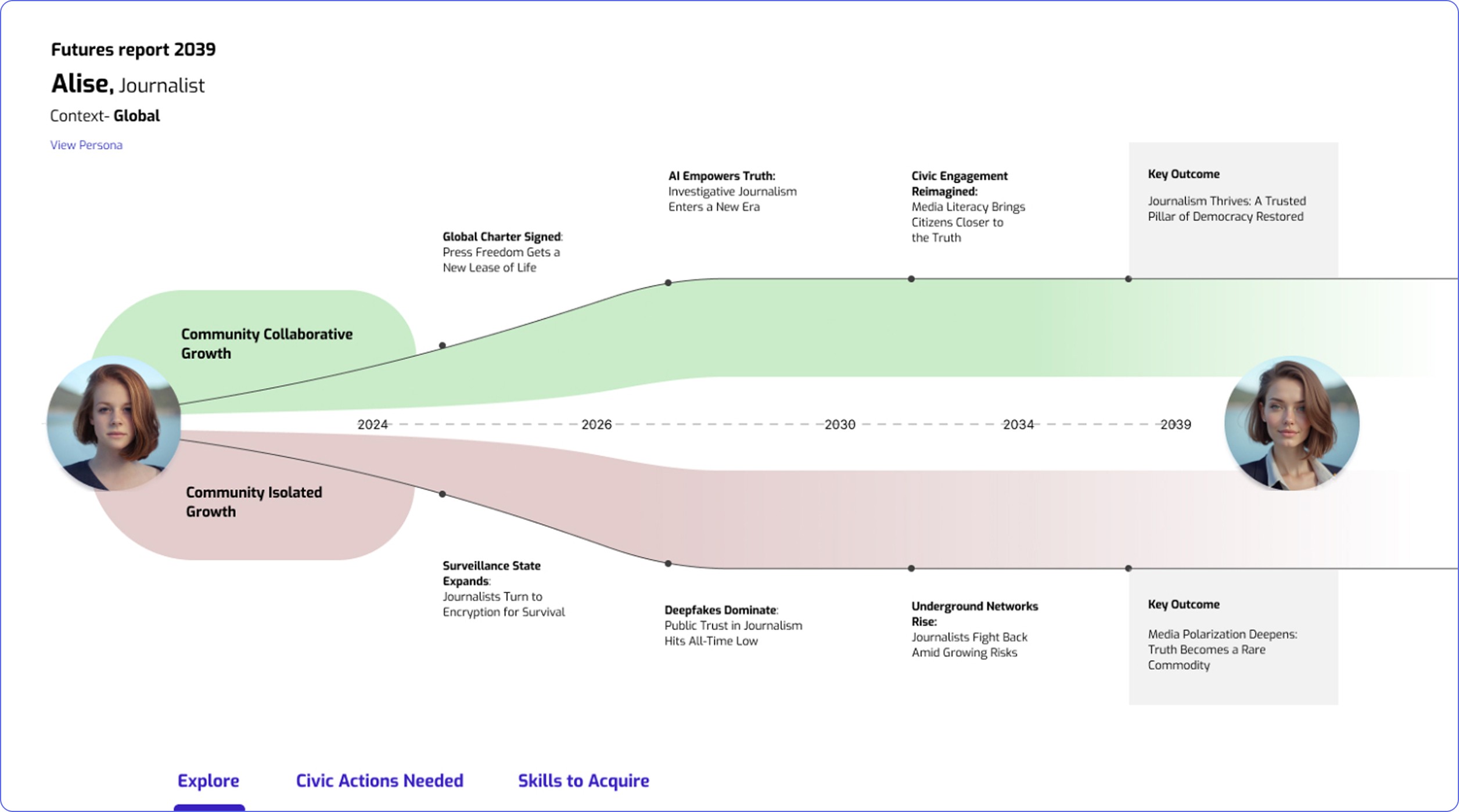
Arkos: The Age of Consequence — Making Systems Thinking Feel Consequential
Arkos uses hybrid game design and AI-assisted simulation to put university students in the seat of a global minister — forcing them to feel, not just understand, how their policy choices ripple across social, economic, and environmental systems.
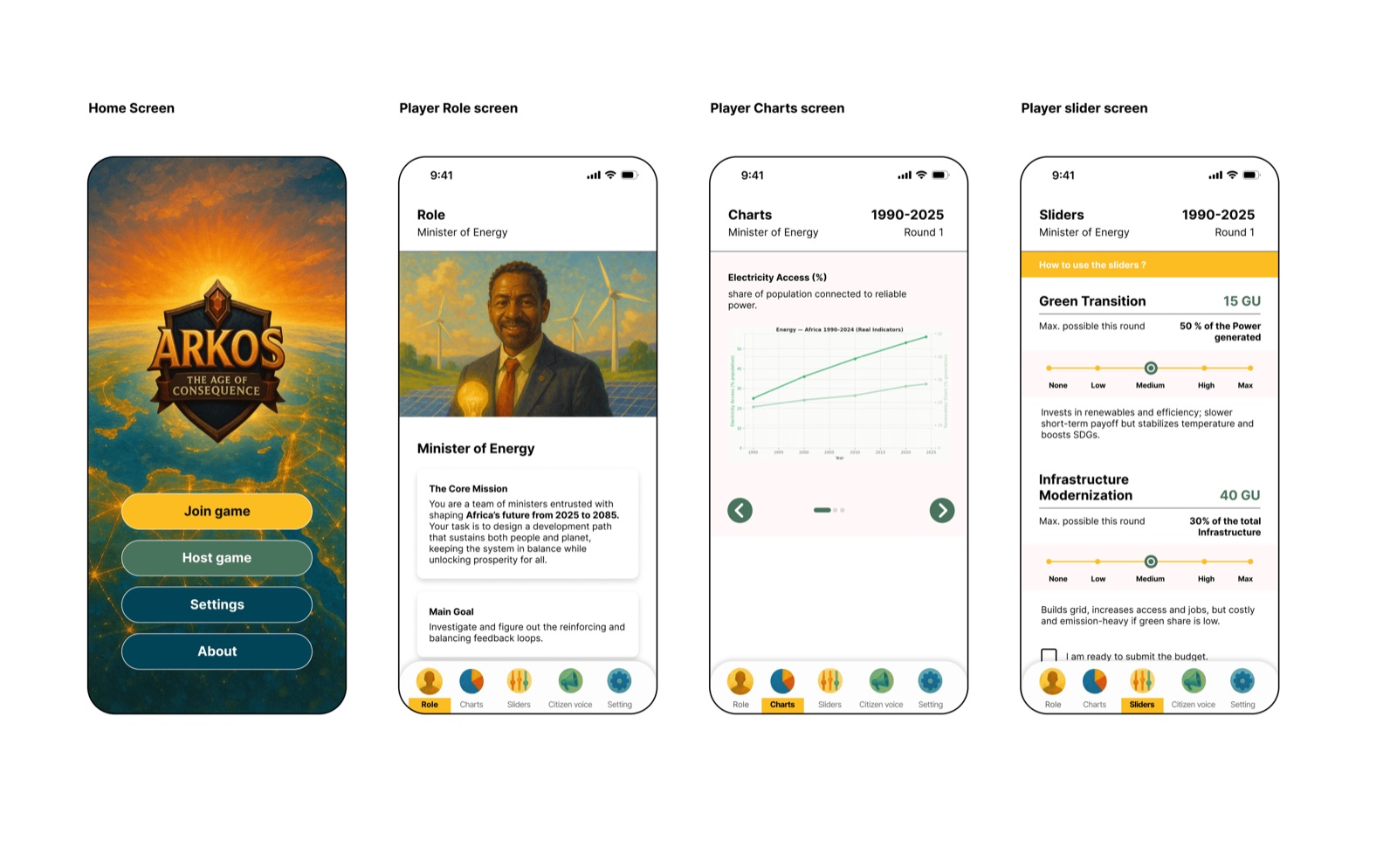
Redesign the experience in 8 weeks — shorter, more emotionally resonant, and far less overwhelming — without sacrificing the learning depth of the underlying Earth4All model, and without the team being able to rebuild that model.
- Make the workshop easier to facilitate
- Reduce workshop duration
- Preserve learning outcomes while scaling the format
- Build empathy across different stakeholder perspectives
- Understand complex systems through relatable perspectives
- Spend less time learning how the exercise works
- Spend more time exploring, playing and learning through the experience
- Understand how decisions affect different actors within a system
Observed playtests and mapped where curiosity turned to confusion. Made three concrete moves: cut the interface down to two policy sliders per ministry, rebuilt onboarding to teach one causal loop before revealing the rest, and made the systems map visible as a puzzle players assembled through play rather than a diagram they were shown. With ChatGPT as invisible infrastructure standing in for the game, the result was a 2-hour session — down from 3–4 — that reduced the information load during onboarding.
- UX/UI design — all screens, interaction flows, and visual system
- Information architecture — structure of the player and facilitator app
- Figma prototype (click-through, linked to all game states)
- AI simulation logic — designed the ChatGPT prompt architecture used to generate game outcomes, news bulletins, and citizen voices
- User research — player interviews and playtests of the original simulation
- Customer journey and empathy mapping
- Benchmark analysis of serious games (7 games reviewed)
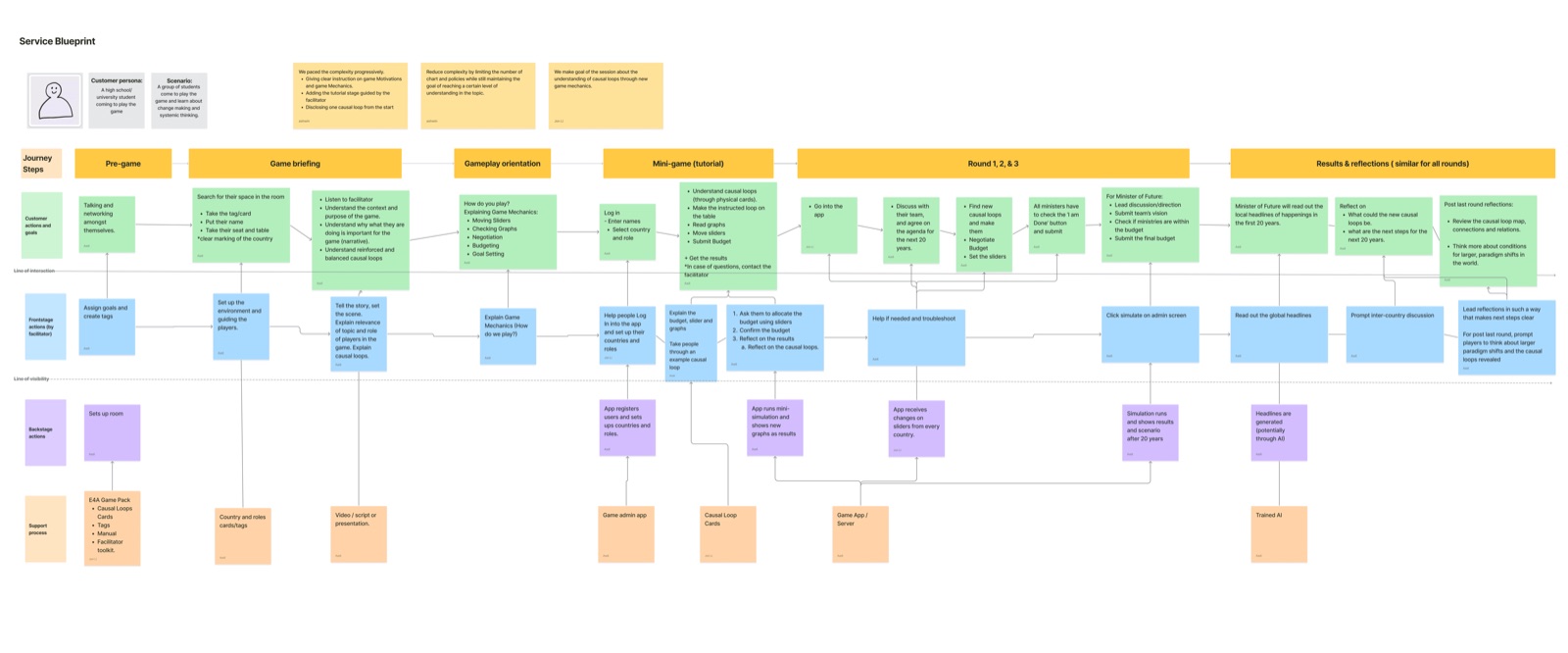
- Service blueprint
- Facilitation design and live testing
- Game logic and causal loop framework
Team: Aadi Rao, Ashwin Vasudevan, Joan Yieke, Jon Li Yeng, Michael Fua · Tools: Figma, Miro, ChatGPT, Service Blueprint
All three learning outcomes met — players demonstrated understanding of causal loops, cross-ministry interdependence, and the human cost of systemic trade-offs. BlueWay issued a formal letter of recommendation, citing the team’s improvement of the simulation’s user experience and its innovative use of AI as a teaching tool.
The existing Earth4All simulation could not be modified by either the team or the client. To test whether players could understand the system and make meaningful decisions within it, we designed a Wizard-of-Oz prototype using ChatGPT as the simulation engine. It processed each ministry’s slider choices and generated dashboards, news headlines, and citizen voices in real time.
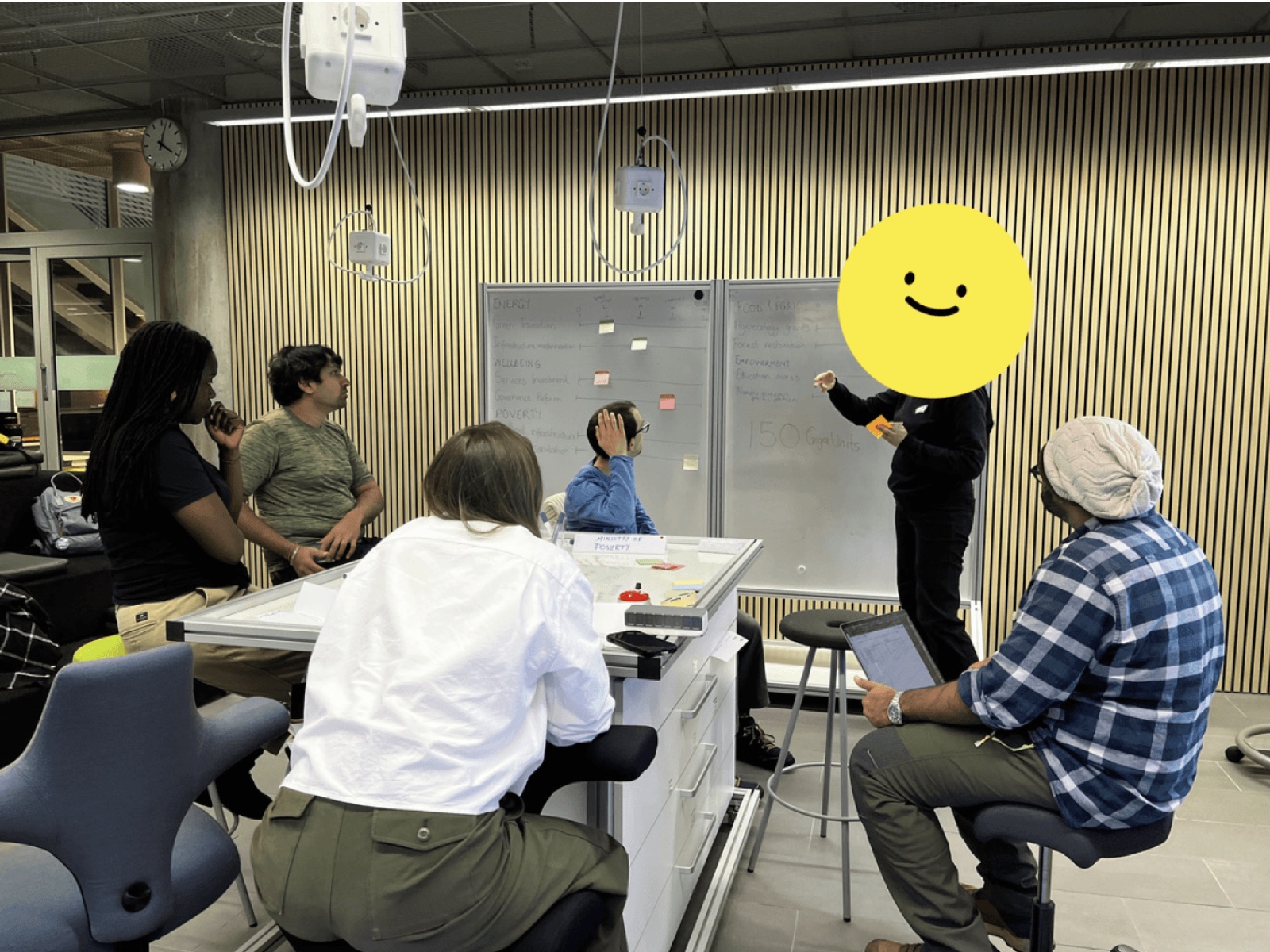
How Arkos got made — redesign, prototyping, and what changed
Earth4All is a hybrid workshop game built on systems-thinking tools for education — a simulation grounded in real economic and climate modelling, designed to show how global policy choices interact across decades. BlueWay, the organisation behind it, came to us with a specific problem: the complexity of the game was causing players to disengage before they could experience what made it compelling.
Sessions ran 3–4 hours. Participants arrived curious and left exhausted. The front-loaded complexity — dozens of unfamiliar indicators, abstract policy sliders, and dense graphs — created a cognitive wall that players spent most of the session climbing rather than playing. The system was sophisticated. The experience wasn’t designed.
We had 8 weeks to change that, without sacrificing the learning depth that made Earth4All worth playing in the first place.
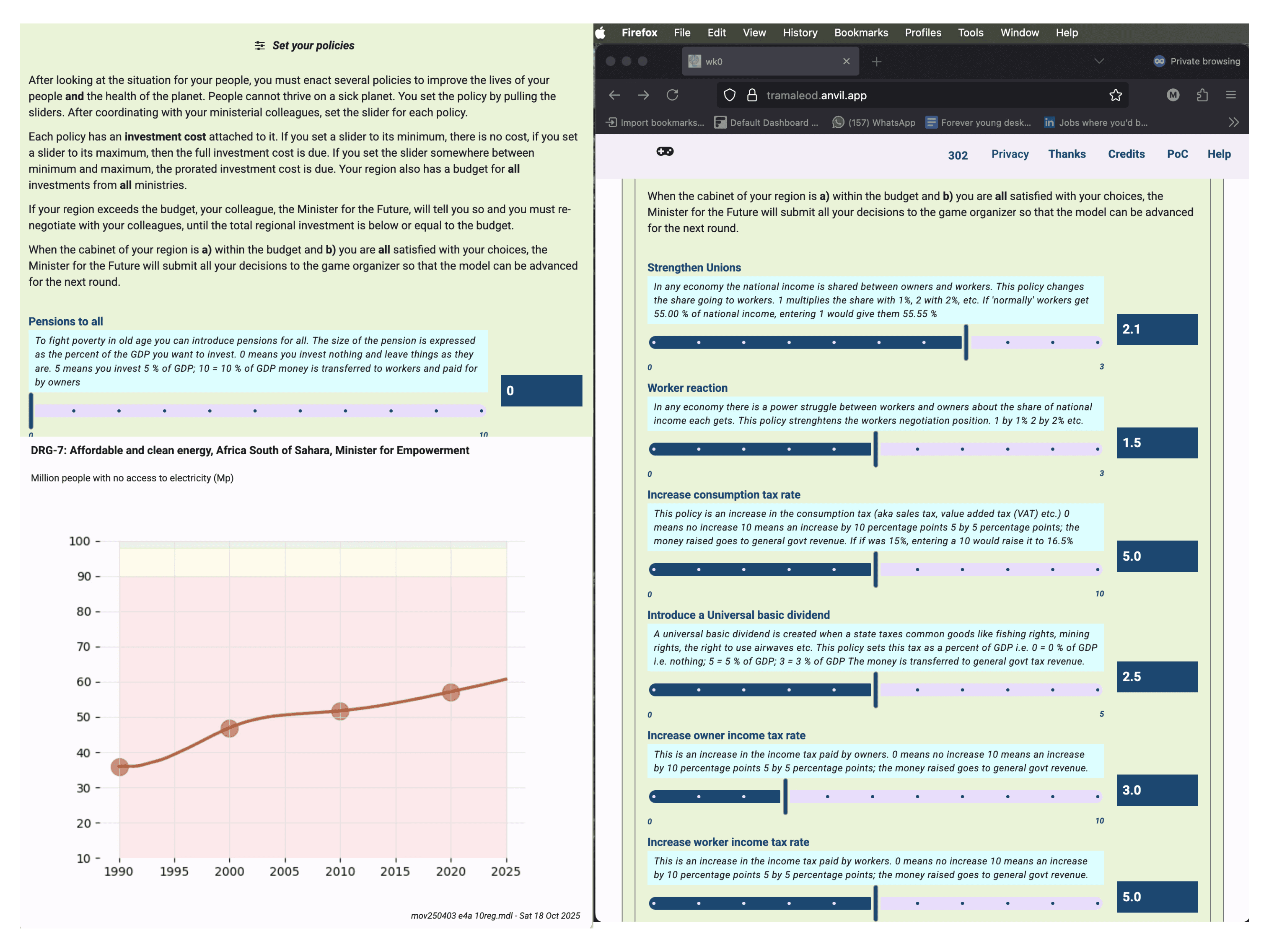
The project followed the Double Diamond — but the real discipline was in resisting the urge to redesign before we understood what was actually breaking. Every phase tested desirability, viability, and feasibility before we moved forward.
Discover
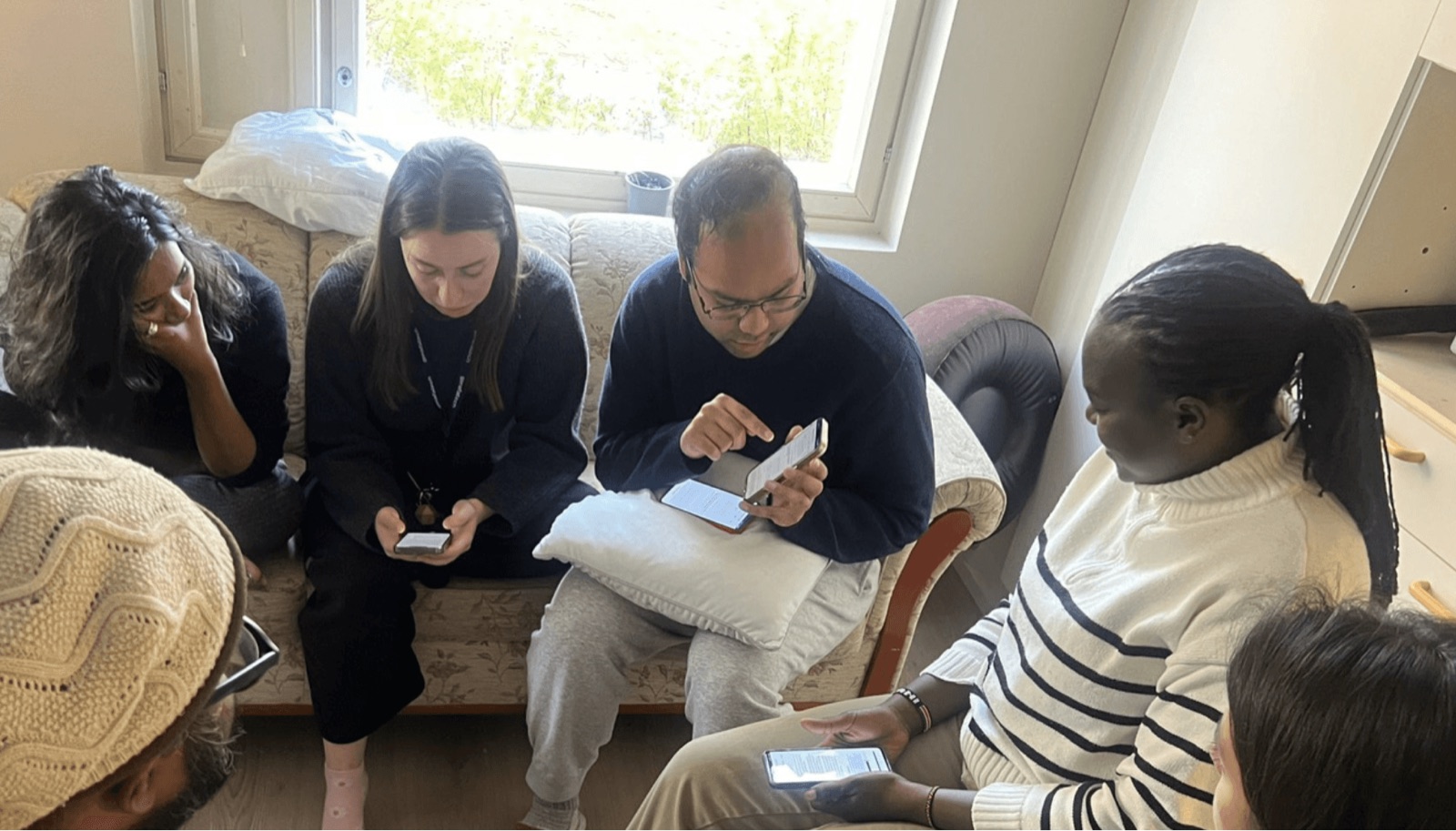
Observed playtests of the original Earth4All simulation. Interviewed participants from the AEMS Summer School who had played it. Mapped the emotional journey to identify when curiosity turned to confusion and when it came back.
Engagement dropped during data-heavy introductions and spiked the moment debate began. The content was desirable. The delivery wasn’t.
Define
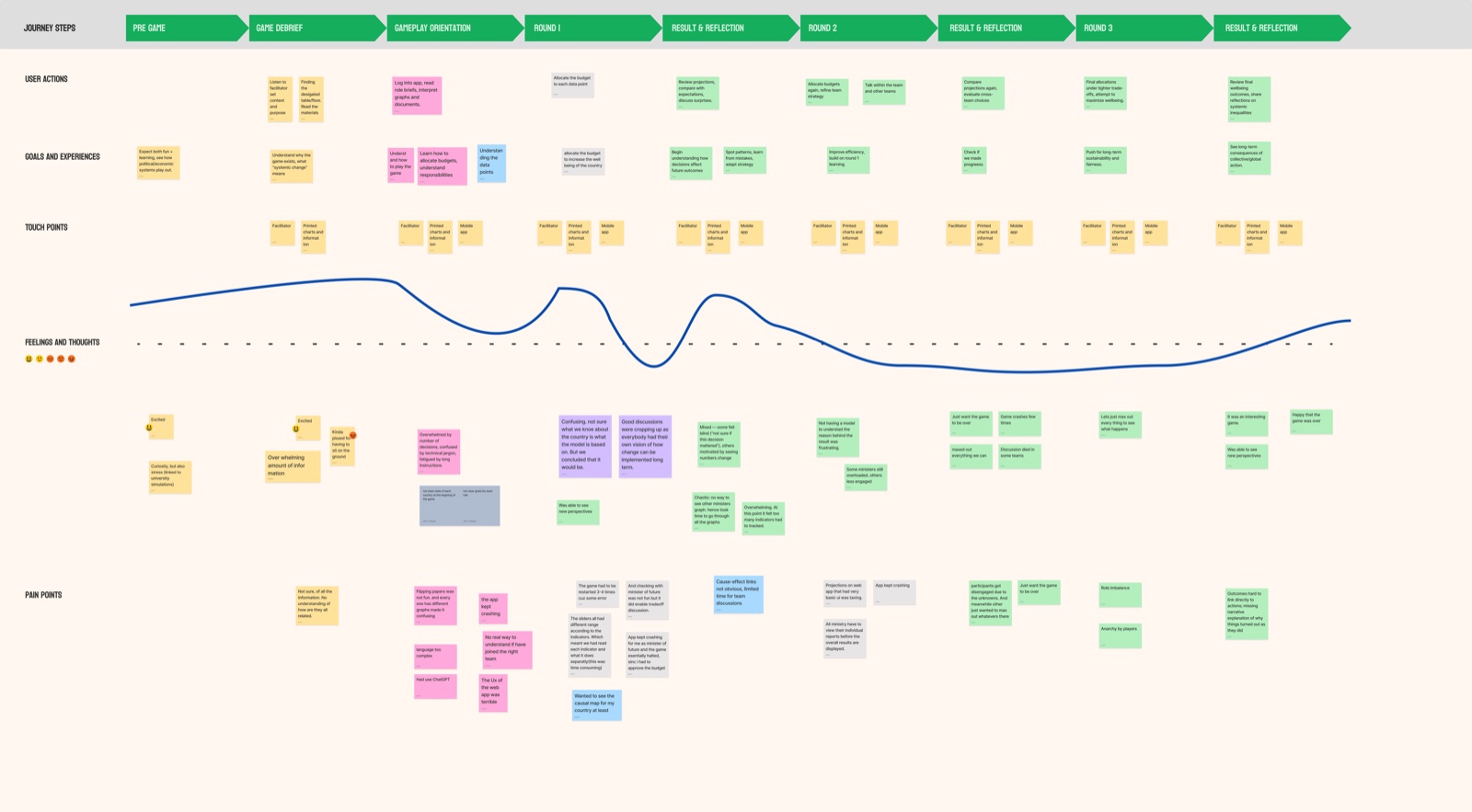
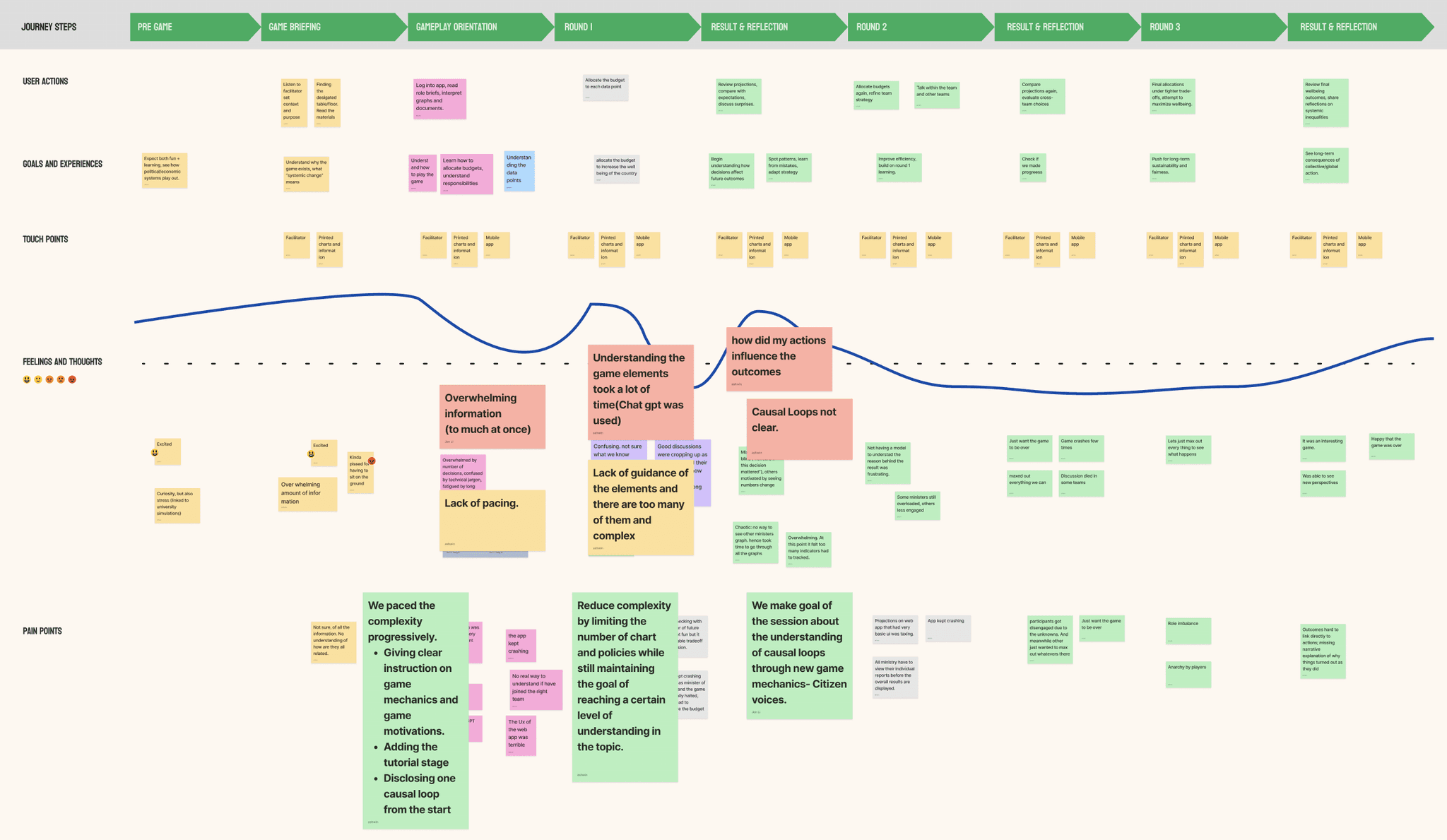
Built empathy maps and a customer journey map that traced four emotional phases: anticipation, cognitive overload, re-engagement, reflection. Benchmarked 7 serious games — from 2030 SDG Games to Climate Fresk — to understand how others paced complexity and used narrative to sustain engagement.
How might we redesign the game into a well-paced hybrid experience where players must collaborate and negotiate, and under the guidance of facilitators, understand social, economic and environmental interconnections, and experience causal loops and time delays?
Develop
Reframed the challenge from ‘how do we explain Earth4All better’ to ‘how do we make players feel the consequences of their decisions before they understand the system.’ That shift drove every design decision that followed. We reduced the number of data points, redesigned role objectives and slider logic, and introduced citizen voices to increase empathy instead of just numbers.
Leading by empathy.
Deliver
Built and tested the full Arkos prototype with university students playing as ministers of the African region, 2025–2085. One round. Five ministries. Two sliders each.
The original simulation ran on a complex system dynamics model — neither we nor the client could rebuild it. So we chose a different path: use ChatGPT as the simulation engine, taking player slider inputs and processing them through 16 documented causal loops to output dashboard indicators, news headlines, and citizen voice quotes. Every policy choice fed into the AI, which returned updated indicators, a global news bulletin, and citizen voices from the communities affected. Tested across all three lenses: desirability, viability, feasibility.
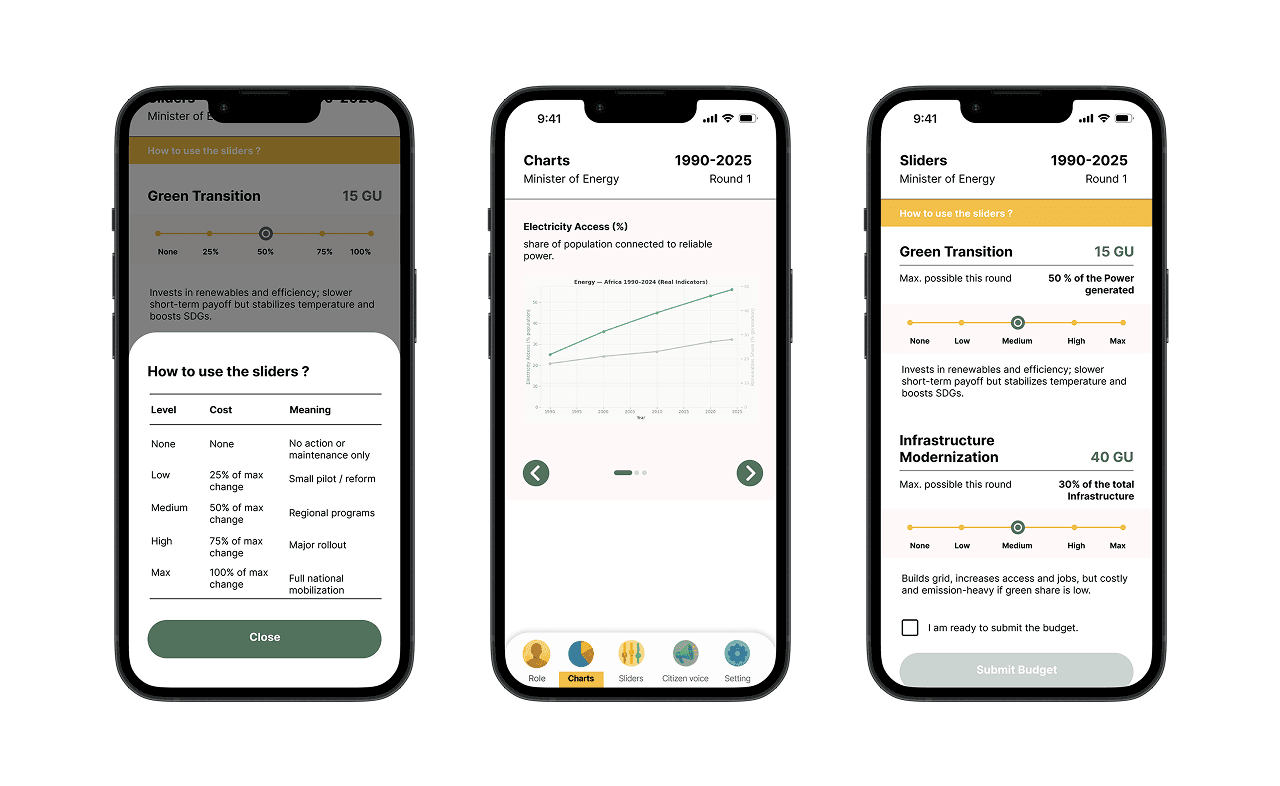
Arkos: The Age of Consequence is a 2-hour, facilitator-led hybrid simulation. Players assume ministerial roles in a fictional region (Africa, 2025–2085), each responsible for two indicators and two policy sliders. Every round, ministers negotiate budget allocation, submit their policy choices, and receive AI-generated outcomes: updated indicator dashboards, a global news headline, and citizen voice quotes that narrate the human consequences of their collective decisions.
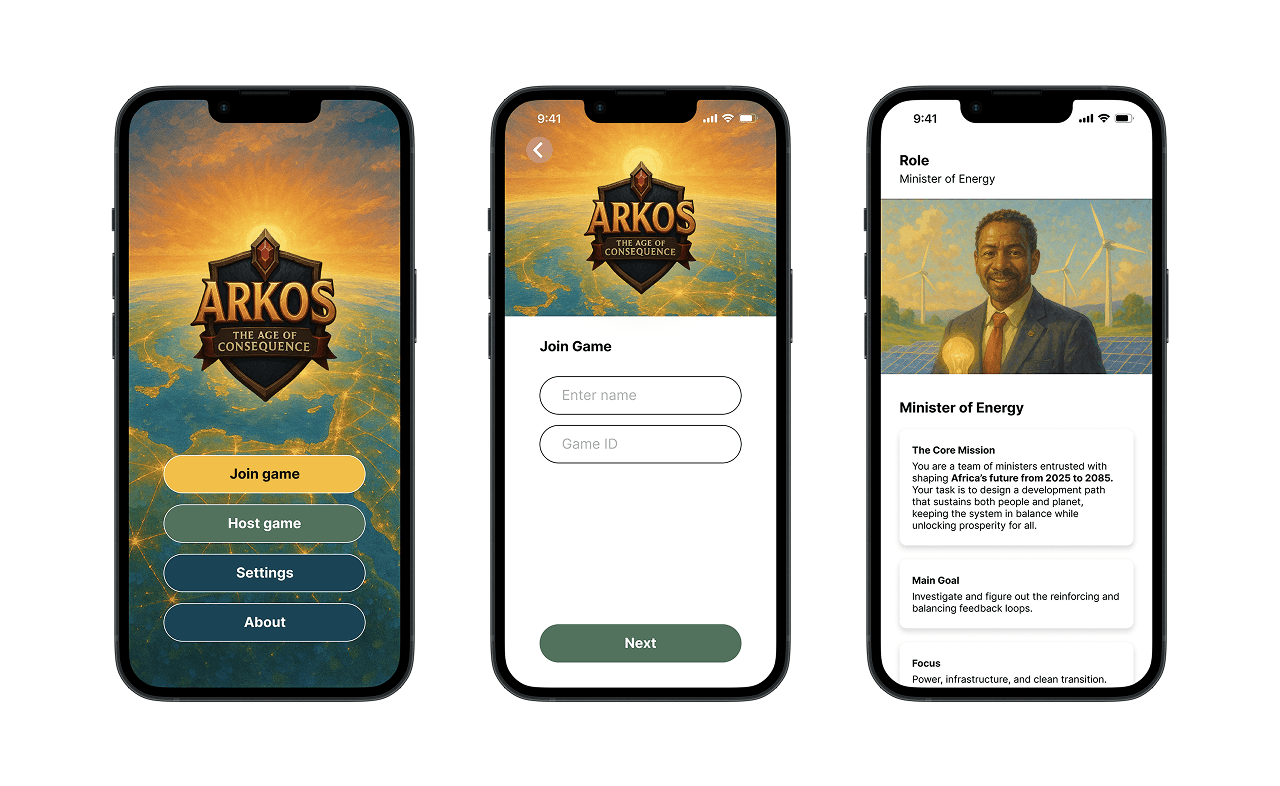
The game operates across two layers. The digital app (designed in Figma, prototyped as a click-through) handles role briefings, charts, sliders, citizen voices, and facilitator controls. The physical layer — whiteboards, causal loop cards, and the ministry table — keeps players looking at each other rather than at screens.
“I like the element of systems thinking and the fact that one influences others.”
“Even if you try to do good it might have side effects.”
“Feedback and reinforcing loops concepts are interesting but I need to read more about it.”
BlueWay issued a formal letter of recommendation. Ulrich Golüke wrote that the team demonstrated “strong analytical and creative abilities in improving the overall user experience of the simulation” and that their “innovative use of AI helped transform the simulation into a more dynamic and accessible teaching tool.”
Arkos proved that the hardest part of designing for systems thinking isn’t communicating complexity — it’s creating the conditions where people feel motivated to understand it. The breakthrough came when we stopped treating the Earth4All model as the thing to explain and started treating player emotion as the design material. Once we built around curiosity and consequence rather than data and instruction, the complexity took care of itself.
What I’d do differently
The AI simulation worked — but it was fragile. We redesigned the prompt architecture three times during testing before the outputs were consistent enough to run a live session without intervention. A second version needs a more robust simulation layer: either a real system dynamics model or a structured rules engine that ChatGPT wraps narrative around rather than drives.
The facilitator toolkit was designed in parallel with testing rather than before it. It worked, but some facilitation decisions were made on the fly during the live session. The toolkit should be co-designed with facilitators across at least two pilots before it’s handed over.
What I learned
Designing for learning is designing for pacing. The emotional sequence — feel something, then understand why you felt it — is more effective than explain then experience. Every serious game I’d work on after this would start with that principle.
AI is a design material, not a feature. The question isn’t ‘how do we use AI’ but ‘what job does this do in the service, and is AI the right tool for that specific job?’ In Arkos, the job was generating plausible systemic consequences in real time without a real model. AI was exactly right for that. It would have been exactly wrong as a replacement for human facilitation.